Underwater Glider Workshop 2026
Ok, admittedly this is a little late but I feel like I should at least put something up.
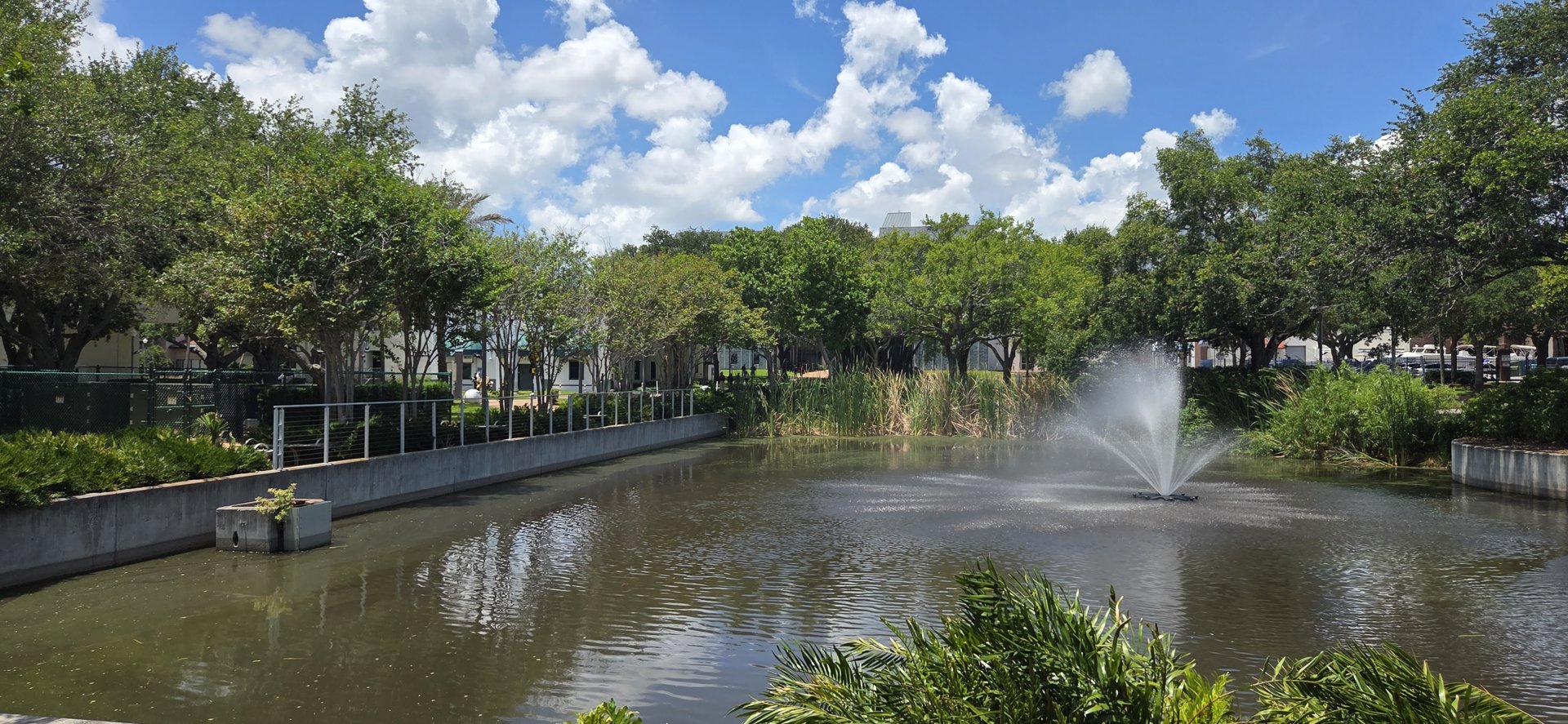
The Underwater Glider Workshop (it was a conference) took place this year in St. Petersburg, Florida. It was from May 18-20 right on the University of South Florida campus. This was a couple of weeks after a devastating fire at the campus destroyed the local marine sciences lab, something which both workshop attendees and the news confirmed to be causted by a lightning strike. The old marine sciences lab had a historical wooden roof, mostly kept for aesthetics purposes, which unfortunately was highly flammible. A ballasting tank, pressure calibration bench, servicing benches, tools, and parts were destroyed in addition to much of the structure. However, Chad Lembke clarified that not all was lost - two gliders were found buried under the rubble and were able to be powered on! The most important thing was that no one was hurt and the department will be able to keep moving.
Day 1
There was a lot to like during the first day. At VOTO, we’ve very proud of our 5-year timeseries in the Baltic Sea. We’ve managed near-continuous observations at multiple sites and it has understandably been quite a bit of work. It was then humbling, however, to hear about multidecadal projects in the Gulf of Mexico or off the coast of California. It’s a reminder that gliders have been around for a long time and the field has had to evolve continuously. Eventually, VOTO will be there and when we are, we’ll have lots to talk about. There was an emerging theme in the upcoming OG1.0 format, which seeks to homogenize glider data. It’s kinda like the standardization of cell phone chargers. For years, you couldn’t plug and play between Android and iPhone. Or even multiple years of iPhone - it seemed like the charger would change on a whim and it was anti-consumer. When Apple adopted USB-C a few years back, it was described as something “already universal” and “the same cable can charge Mac, iPad, iPhone…”. OG1.0 will take the “spaghetti” of different glider formats and make them play nice together. All of a sudden, I can use data from other labs without being trained in how a specific type of data works. And the community is really excited about that, too. Metadata standards will help provide context to the data that people have. Flagging methods will be clarified, such that it’s easy to ID which data points are defined as good or bad. I won’t have to worry about if my temperature data is called “TEMP” or “temp_c” or “t1” across different datasets. Seeing this makes me wish that there was a similar standard for CTD data. Working in the IAPSO CTD-O2 workgroup, this can be a sticking point. CTDs predate Gliders by about 20 years and, though they don’t collect as much data in general, they are the best way to produce high-quality data. A CTD requires an operator, and said operator can then make post-fit corrections using Niskin bottle samples. That’s harder to do with a glider, since it’s remotely operated and corrections are a challenge given spatiotemporal variability. Yet, there is no standard for CTD data. CTD manufacturers have come and gone over the years, with the original Neil Brown MkIIIs evolving into the ubiquitous SBE9 manufactured by SeaBird, yet there hasn’t been such a standard. Sometimes your CTD data is a frequency. Sometimes it’s in an old standard. If you use different datasets, you most likely will need to do some kind of homogenizing step to get everything to talk together.
But I digress. Day 1 was a lovely introduction to the UG2 sphere which I’ve only really experienced through the narrow lens of their Slack channel.
Day 2
Day 2 was very different. At this stage, we were able to explore a little more related to where the field is going and what some of the major developments have been. AI has become an incredibly common topic and it’s arguably more divisive now than ever. In 2023, I couldn’t count on AI to count to 10 much less be able to create tools for filtering 20 years of bioacoustic data. Yet during the workshop, it was demo’d in real-time. We were able to listen to the raw data, noisy as it was, and we could tell that there were porpoise calls in there. Then with a single press of a button, a 20-second AI-built toolbox managed to filter all the noise out, ID features of interest, and generate a report on what it found. Basically, it took the work of a team of undergrads working for 3 months, painstakingly flagging regions of whale calls and figuring out filter parameters, and condensed all the work into 20 seconds and maybe $2 worth of AI tokens. Of course, developing the tools themselves takes a lot more effort than that. But I was introduced to AI teams, where one AI agent was assigned a certain role and another agent would then check on them. So this whole team of robots was responsible for writing the 5000+ lines of code that were paired with acoustic data which, given funding and manpower constraints, hadn’t been touched in years. That demo highlighted:
- As our data gets bigger, it will become incresingly impossible for humans to handle it all manually.
- Regardless of which tool you use, you need to think critically. I intend to keep an open mind, but not so open that my brain falls out.
- AI is great for small teams, either in manpower or funding, to build pipelines or routines that lead to higher-quality products.
It was similar to an example from Ocean Sciences, where the NOAA tide gauges were tied to an AI agent which could then summarize key findings or provide data products that non-experts could use. While a scientist or data tech could just as easily do that with more detail, the ease of which a simple question can be asked is incredibly powerful.
Of course, the questions following the demo showed just how divisive the use of AI is and the number one fear is atrophy. I’m working through the Google Summer of Code, where I’m learning how to be a better programmer. It’s extremely, extremely tempting at times to just pass a prompt off to Claude or something and have it write my code for me. But that defeats the whole purpose of the project. And what’s more, it actively hurts my ability to code. It can be an excellent learning tool if used correctly, and it can also do some things that you don’t have time for, but there is a time and a place for this tool like any other. Building a house with only a hammer isn’t the same as having the whole toolbox. AI is kinda like a Swiss-army knife that fits a lot of applications, but it’s still a tool. I wouldn’t use it over a hammer, or a crimper, or an impact driver if those other tools are available.
That’s something I’ve noticed since living in Sweden, which is that Europe as a whole sees it more like a tool. It isn’t quite vilified the same way. Certain tools, like video or image generation are, but when it comes to coding or writing it’s seen as a way to break down barriers. The “I don’t know how to get started on this” question can be hard to answer from search engine queries alone. Of course, the environmental impact of AI is commonly brought up among our group since we, as an environmentally-minded company should be. It’s one of those tools or topics that should require training on. Like playing a game of CIV - this unit could be overkill for what I intend to accomplish and the rest of my civilization may be neglected if I decided to use it instead. Again, use your brain.
Day 3
The conference wrapped up with some encouraging talks. I think the one I was most happy to hear about was the student-led glider lab at the University of Washington. I worked with Sasha Seroy and Miles Logsdon when I was an undergraduate and it’s cool to see that she and Rick Rupan have managed to create a self-sustaining student ecosystem that is able to collect meaningful data. The students themselves ask the scientific questions, they consult with “stakeholders” or those that would benefit from getting data in a particular location, and they oversee the needs to deploy in specific areas.
Thus far, it seems like they have 8 donated seagliders (the kind built by Charlie Eriksen and Fritz Stahr) with business, technical, and science teams. Because it’s an undergrad operation, there’s heavy student turnover and training has been a key aspect of the center. I think there is a lot to be learned from this and, given the relationship between VOTO, the University of Gothenburg, and Chalmers University here in Gothenburg, I could see something similar emerging. Mariarita at IFREMER sounded interested in putting something similar together in Europe.
Given how much the students have accomplished (they’re continuously adding to the OTTERS timeseries across Puget Sound) with a limited budget, driven almost entirely by student engagement and donations, it reminds me of the legacy hardware I had around me at Scripps. SIO has always been at the forefront of some kind of ocean research, but what do you do with equipment when it becomes antiquated? When that new, fancy budget rolls through to use the new sensors with an extra order of accuracy. The UW Glider center shows that the old stuff is still perfectly useable and with a good mentor can be given a second life. At SIO we had dozens of old-style Niskin bottles that were no longer usable for our GO-SHIP cruises, as they were 1) too heavy or 2) required niche tools or parts to maintain. We put a post in the SIO listserv that we had Niskin bottles available, and we got a large amount of interest from different groups. One was the Birch Aquarium, which wanted them for a display. Another was a grad student that wanted to take samples the old-fashioned way (with a messenger traveling down the line). And another was from someone that worked with Sir David Keeling’s lab - they still had these types of bottles and were ready to expand their inventory. I think of the alternative - sending the bottles to the dump or campus recycling center and it makes me shudder somewhat to think about the missed opportunities. That happened, as far as I’m aware, with the SeaSoar. The SeaSoar was a towed CTD, kind of like a tow-yo, that had fins and specialized on occupying a certain depth. It was a monster to maintain - there were numerous stories and boxes of cable fairings that highlighted how much work went into maintaining the device. When I was hired on, we had two complete SeaSoars on site, with additional parts, oil, and deployment equipment that took up nearly a room in and of itself. They were getting phased out at WHOI and OSU, so we had boxes with labels for the various labs they had once occupied. SIO has a smaller vessel, the Bob and Betty Beyster, which may be too small for SeaSoar operations, but there are examples of citizen scientists going around and taking measurements. I wonder if, on a larger scale and outside of the beaurocracy of the University of California, these SeaSoar units could have found a second wind in the way that the UW glider lab has.